
The San Francisco 49ers enter the 2026 NFL season with a defense full of promise — and a list of questions that demand answers.
Injuries derailed what looked like a dominant unit in 2025, but the returning health of key players, a revamped coaching staff, and a draft class loaded with defensive talent give the 49ers real reason for optimism.
Here is everything you need to know about the 49ers’ defense heading into 2026.
The 2025 season tested the 49ers’ defensive depth in ways few anticipated.
Nick Bosa suffered a torn ACL and missed 14 games. Mykel Williams, the 2025 first-round pick, went down with the same injury and sat out half the year. Fred Warner missed 11 games.
Despite those devastating losses, the defense still helped the team finish 12-5 and earn a playoff berth.
The numbers tell a complicated story. San Francisco allowed 340.2 total yards per game (20th in the NFL), 371 points (13th in points allowed), and posted an EPA/play of 0.06 (24th).
The pass defense ranked 24th, allowing 4,110 yards through the air and 29 touchdown passes.
The run defense, however, held steady at 11th, a bright spot anchored by promising rookies.
Early 2026 projections place the defense between 15th and 19th overall. If Bosa and Williams return healthy and Morris maximizes the talent around him, a top-10 finish is realistic.
The pass defense carries the most room for improvement. San Francisco generated a meager 3.16% sack rate in 2025 — a direct consequence of playing most of the season without Bosa.
A healthy front seven should push that number significantly higher.
The secondary also ranked 25th in pass defense, 21st in touchdown passes allowed, and 29th in interceptions forced — areas Morris and the front office are actively addressing this offseason.
Players To Watch Out For
Nick Bosa
Everything starts with Bosa. The 49ers pay him $42 million annually because he changes games, and his absence in 2025 exposed just how dependent the defense is on his presence.
When healthy, Bosa ranks among the premier pass rushers in the NFL, and his return-to-form will set the ceiling for this entire unit. He carries the No. 57 spot on the NFL Top 100, a testament to his peers’ respect even after a lost season.
Fred Warner
Warner is a generational talent at linebacker — No. 16 on the NFL Top 100 — and the operational center of San Francisco’s defense.
When he lines up healthy, the defense communicates, adjusts, and executes at an elite level. His presence unlocks the complexity Morris wants to deploy.
Mykel Williams
The 2025 first-round pick brings rare athleticism and a high ceiling to the left defensive end spot.
His torn ACL slowed his progress as a rookie, but he has the potential to be a key player next to Bosa because he is good at stopping runs and rushing the passer.
Williams’ growth in 2026 could give San Francisco the real two-headed pass-rush threat the team has been looking for for years.
Deommodore Lenoir
Lenoir holds down the right cornerback position as a reliable starter who carries a $8.9 million cap hit in 2026 — a reasonable investment for a player who provides consistency on the outside.
He gives the 49ers a settled presence in a secondary that needs stability.
Ji’Ayir Brown and Malik Mustapha
Brown plays the strong safety role reliably, while Mustapha — a 2025 fourth-round rookie — projects as a box safety with a physical, downhill style.
The pairing works, but the unit needs a rangier coverage safety to protect the back end from vertical attacks.
Addressing this need, whether through free agency or the draft, stands as one of the most pressing defensive priorities of the offseason.
The Minkah Fitzpatrick Factor
The Miami Dolphins’ roster teardown has created an unexpected opportunity.
Miami has fielded calls about trading five-time Pro Bowl safety Minkah Fitzpatrick, and CBS Sports has floated the 49ers as a prime landing spot.
Fitzpatrick is 30 years old and entering the final year of his four-year, $73.6 million contract.
He owes $15.6 million against the cap in 2026 — a number Miami appears willing to move.
Last season he posted 82 tackles, one interception, two fumble recoveries, and a forced fumble across 14 games before the Dolphins began dismantling the roster.
His versatility makes him a natural fit for Morris’s scheme. Fitzpatrick lines up at free safety, in the slot, as a linebacker, and on the edge — a rare skillset that gives coordinators genuine flexibility.
The cost should remain manageable: a fourth-round pick or a combination involving a younger safety and a late-round selection represents a realistic price given Miami’s urgency.
Fitzpatrick does not need to replicate his Pittsburgh peak to help San Francisco.
A steadying veteran presence in a secondary that has lacked one could prove transformative. The 49ers need to move quickly.
2026 NFL Draft Targets
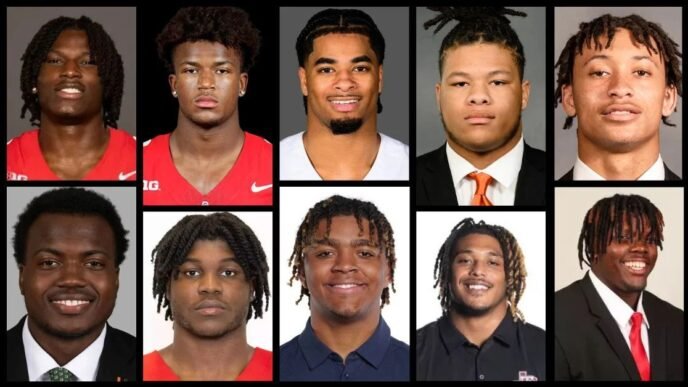
The 49ers hold the 27th pick and carry enough cap space to be active in multiple phases of team-building. Here are the five defensive prospects most worth tracking:
T.J. Parker, EDGE, Clemson (1st Round) — Parker lacks elite foot speed but brings heavy hands, strong upper-body power, and a hard edge-setting ability that could make him a functional No. 2 rusher opposite Bosa.
He projects as a three-down player who can grow into a significant role as his pass-rush plan matures.
Emmanuel McNeil-Warren, Safety, Toledo (1st Round) — McNeil-Warren earned a 92.2 PFF coverage grade in 2025 with a 33.3% forced incompletion rate and 14 career takeaways.
His downhill explosiveness and nose for the football address the exact void the 49ers carry at safety.
Run defense remains a work in progress, but his coverage upside is the closest fit to the 49ers’ need potentially available at 27th overall.
Zion Young, EDGE, Missouri (2nd Round) — Young brings an 86.6 run defense grade and a 9.3% stop rate as a second-round prospect who could allow the 49ers to kick Williams inside and bolster the run defense as a rotational piece.
His pass-rush plan needs refinement, but with Bosa, Williams, and Bryce Huff ahead of him, San Francisco gives him the ideal environment to develop.
Brandon Cisse, CB, South Carolina (2nd Round) — Cisse’s 89.2 run defense grade stands out, and his coverage has improved steadily across three seasons with the Gamecocks.
He may not start immediately, but banking on his rare explosiveness and upside gives the 49ers a high-ceiling developmental corner, especially after Renardo Green’s inconsistent 2025 season.
Kyle Louis, LB, Pitt (3rd or 4th Round) — Louis is undersized at 5-foot-11 and 225 pounds, but he is a chess piece who fits Morris’s hybrid defensive concepts.
He posted an 86.2 run defense grade and an 86.7 coverage grade in the box since 2024. His ability to slide into the slot as a big nickel gives the 49ers flexibility as they search for a starter alongside Warner.
Tactical Breakdown: Morris Takes The Wheel
Under Saleh, San Francisco ran a base 4-3 defense emphasizing wide-9 alignments for edge rushers, man coverage in the secondary, and aggressive run fits.
The scheme produced a top-five unit early in 2025 before injuries forced simplified coverages and heavy use of dime packages.
The result was a defense vulnerable to explosive plays — particularly in the passing game.
Morris brings adaptability. He will not blow up what works. Instead, he will evolve the scheme around the personnel available.
Front Seven Evolution — Expect Morris to deploy more 5-1 “Penny” fronts, placing five defensive linemen on the field to maximize pressure without relying on a linebacker corps thinned by years of attrition.
San Francisco has lost Dre Greenlaw and Azeez Al-Shaair from this unit in recent years, and the depth at linebacker remains thin.
Moving the load to Bosa, Williams, Collins, and West makes sense. Morris will also incorporate hybrid run-and-jump pressures to disrupt quarterback rhythm in ways the Saleh scheme did not consistently generate.
Secondary Adjustments — Look for more zone coverage to protect the back end against explosive plays.
Stout’s versatility enables nickel and dime packages without sacrificing physicality.
Adding a coverage safety — through the draft or via Fitzpatrick — will allow Morris to run cleaner single-high shells and bracket dangerous receivers.
Overall Philosophy — The “next-man-up” mindset that defined 2025 stays intact. Morris values communication, preparation, and physical identity.
The goal is to improve the sack rate from its injury-depressed 3.16%, generate more turnovers from a secondary that finished 29th in interceptions, and build the kind of consistent interior pressure that stresses opposing offensive lines.
If the front gets healthy and the secondary finds a playmaker, a return to top-10 status is not a stretch — it is the expectation.
Final Word
The 2025 season revealed the 49ers’ defensive ceiling and their floor. When healthy, this unit can compete with anyone in the NFC.
When the injuries pile up, the depth thins quickly and the numbers suffer.
The offseason work ahead — whether through Fitzpatrick, the draft, or free agents like Trey Hendrickson and John Franklin-Myers — will determine how quickly the 49ers climb back toward the top of the defensive rankings.
The margin for error in the NFC West has never been smaller. San Francisco cannot afford another season without a playmaking safety and a reliable interior pass rusher.
The talent is there. The coaching adjustment is underway. Now the 49ers need health, timely additions, and the right picks in April to turn a promising rebuild into a dominant defense.